Discover the perfect 3 day exercise plan to build muscle and fit fitness into your busy life. Get full-body, PPL, and home workout routines that work.
A 3-day exercise plan is one of the most effective—and sustainable—ways to build muscle and get fitter, especially if you're juggling a busy life. It strikes that perfect balance between intense training sessions and the crucial recovery days your body needs to repair and grow stronger.
It's a powerful and realistic approach that syncs up perfectly with what health experts recommend for long-term success.
Why a 3-Day Workout Is Your Fitness Sweet Spot
Let's be real: the ambition to hit the gym five or six days a week often collides head-on with the reality of a packed schedule. While it feels like more training should equal better results, it usually just leads to burnout, plateaus, and skipped sessions.
The real magic in fitness isn't found in relentless, day-after-day intensity. It’s built on unwavering consistency.
A three-day workout schedule is the ideal middle ground. It gives you enough stimulus to trigger serious strength and muscle gains while leaving plenty of time for your body to recover and adapt. This isn't just about convenience; it's a strategic move for getting real results.
The Power of Recovery and Consistency
Here’s a secret many people miss: muscle isn’t built in the gym; it’s built during rest. When you lift weights, you create tiny micro-tears in your muscle fibers. It's during your recovery days that your body gets to work repairing these tears, making the muscles bigger and stronger than before.
A 3-day plan gives you four full days each week for this essential process to happen, which dramatically cuts down your risk of overtraining and injury.
The best workout plan is the one you can actually stick to, week in and week out. By making fitness manageable instead of overwhelming, a three-day routine sets you up for the kind of long-term consistency that drives lasting change.
This approach also happens to align perfectly with global health guidelines. The World Health Organization recommends at least 150 minutes of moderate-intensity activity a week, plus two days of muscle-strengthening work. A simple 3-day plan with 45–60 minute sessions easily checks all those boxes.
Research on exercise adherence even shows that workout plans capped at three sessions a week often lead to better long-term consistency than more demanding schedules.
This diagram can help you figure out which type of 3-day plan is the best fit for your main goal.
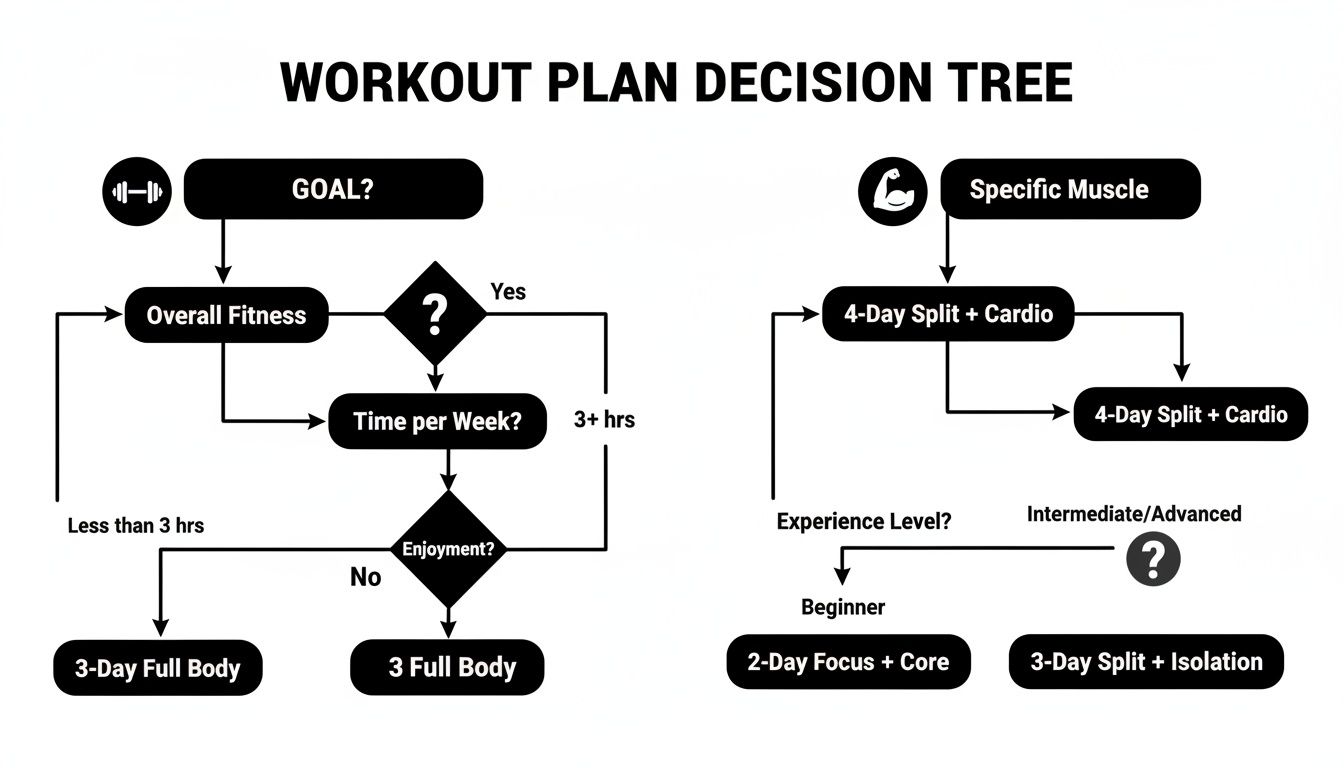
As you can see, the right path depends on whether you're aiming for all-around fitness or want to zero in on specific muscle groups.
Optimizing Your Three Days
So, how do you get the most out of just three workouts a week? It all comes down to efficiency and smart programming. Instead of wasting time on small isolation exercises, the best 3-day plans are built around big, compound movements that hit multiple muscle groups at once.
This is where modern tools can give you a serious edge. An AI-powered app like Zing Coach, for example, can analyze your goals, fitness level, and available equipment to build a perfectly optimized 3-day schedule just for you.
It makes sure every session is challenging enough to drive progress without pushing you toward burnout, and it adapts as you get stronger. By taking the guesswork out of planning, it frees you up to focus on what matters: showing up and putting in the work. For more on this, check out our guide on how to stay consistent with exercise.
The Classic Full-Body 3 Day Workout Plan
If you're looking for maximum bang for your buck, the full-body workout is the undisputed champ. This approach is a fantastic starting point for beginners who need to build a solid foundation, but it's also perfect for experienced lifters wanting to maintain strength without living in the gym.
The idea is simple but incredibly effective: you train your entire body in each session, three times a week.
This high-frequency approach is a game-changer for muscle growth. By hitting major muscle groups—think legs, back, and chest—three times a week instead of just once, you give your body more signals to build new muscle. It's a seriously effective strategy for anyone starting their fitness journey.

This 3-day exercise plan is meant to be done on non-consecutive days, like Monday, Wednesday, and Friday. That schedule gives you a solid 48 hours of recovery time between workouts, which is absolutely crucial for muscle repair and dodging burnout.
Your Weekly Full-Body Schedule
The beauty of this plan is its simplicity and balance. Each day, you'll tackle a compound lift for your lower body, an upper-body push, an upper-body pull, and a bit of accessory work to tie it all together.
Here’s a snapshot of your week. The exercises are the same for all three days. This repetition is intentional—it helps you master the form on these fundamental movements.
Workout A (Perform 3 Times Per Week)
- Goblet Squats: 3 sets of 8-12 reps
- Dumbbell Bench Press: 3 sets of 8-12 reps
- Bent-Over Dumbbell Rows: 3 sets of 8-12 reps
- Overhead Press: 3 sets of 10-15 reps
- Plank: 3 sets, hold for 30-60 seconds
Take a 60-90 second rest between each set. That’s just enough time to get your strength back for the next round but short enough to keep the intensity up. If you're brand new to this, our guide to a beginner strength training program has some extra foundational tips.
Mastering The Movements And Form
Let's be clear: perfecting your form is way more important than how much weight you're lifting. Bad form doesn't just make an exercise less effective; it's a fast track to injury. Your focus should be on controlled, deliberate movements.
Tempo is your secret weapon here. Instead of blasting through reps, use a 2-1-2 tempo:
- 2 seconds to lower the weight (eccentric phase).
- 1 second pause at the bottom of the movement.
- 2 seconds to lift the weight back up (concentric phase).
This deliberate speed takes momentum out of the equation and forces your muscles to do all the work.
Executing each repetition with intent and control builds a strong mind-muscle connection. This focus ensures the target muscles are doing the work, leading to better results and enhanced safety.
For a Goblet Squat, this means taking two full seconds to descend, pausing for a beat at the bottom, and then taking another two seconds to drive back up to the start.
Making It Work For You: Modifications And Progressions
A truly good workout plan has to meet you where you are. Whether you're a total newbie or you've been lifting for years, this full-body plan can be tweaked to fit your level.
For Beginners (Regression):
- Goblet Squat: Just use your bodyweight to start. Nail down the movement pattern before you even think about adding weight.
- Dumbbell Bench Press: If dumbbells are too much, switch to Push-Ups. You can make them easier by doing them from your knees or even against a wall.
- Bent-Over Rows: Grab some very light dumbbells or even a resistance band to get the feel for the hip-hinge and pulling motion.
For Advanced Trainees (Progression):
- Increase the Weight: This is the most obvious path forward. Once you can hit 12 reps on all sets with good form, it's time for heavier dumbbells.
- Add a Set: To increase your total volume, bump up from 3 sets per exercise to 4 sets.
- Try Harder Variations: Swap Goblet Squats for Barbell Front Squats, or trade the Dumbbell Bench Press for a Barbell Bench Press.
The name of the game is progressive overload—the principle of making your workouts a little bit harder over time. If you don't challenge your body, it has no reason to adapt and get stronger.
This is where AI-driven apps like Zing Coach really shine. The app can automatically adjust your workout's difficulty based on your performance and feedback. It ensures you’re always challenged just enough to keep making progress without feeling overwhelmed.
The Push Pull Legs 3-Day Split For Targeted Growth
While a full-body routine is a powerful tool for overall fitness, the Push/Pull/Legs (PPL) split offers a more focused approach for anyone ready to take their training up a notch. This method is a favorite among intermediate lifters for a reason: it allows you to hit specific muscle groups with greater volume and intensity, which can be a game-changer for breaking through plateaus.
The logic behind a PPL split is beautifully simple. You dedicate each of your three training days to a specific movement pattern: pushing, pulling, or working your legs. This structure ensures that while one group of muscles is working hard, the others are getting much-needed rest, promoting optimal recovery and growth.
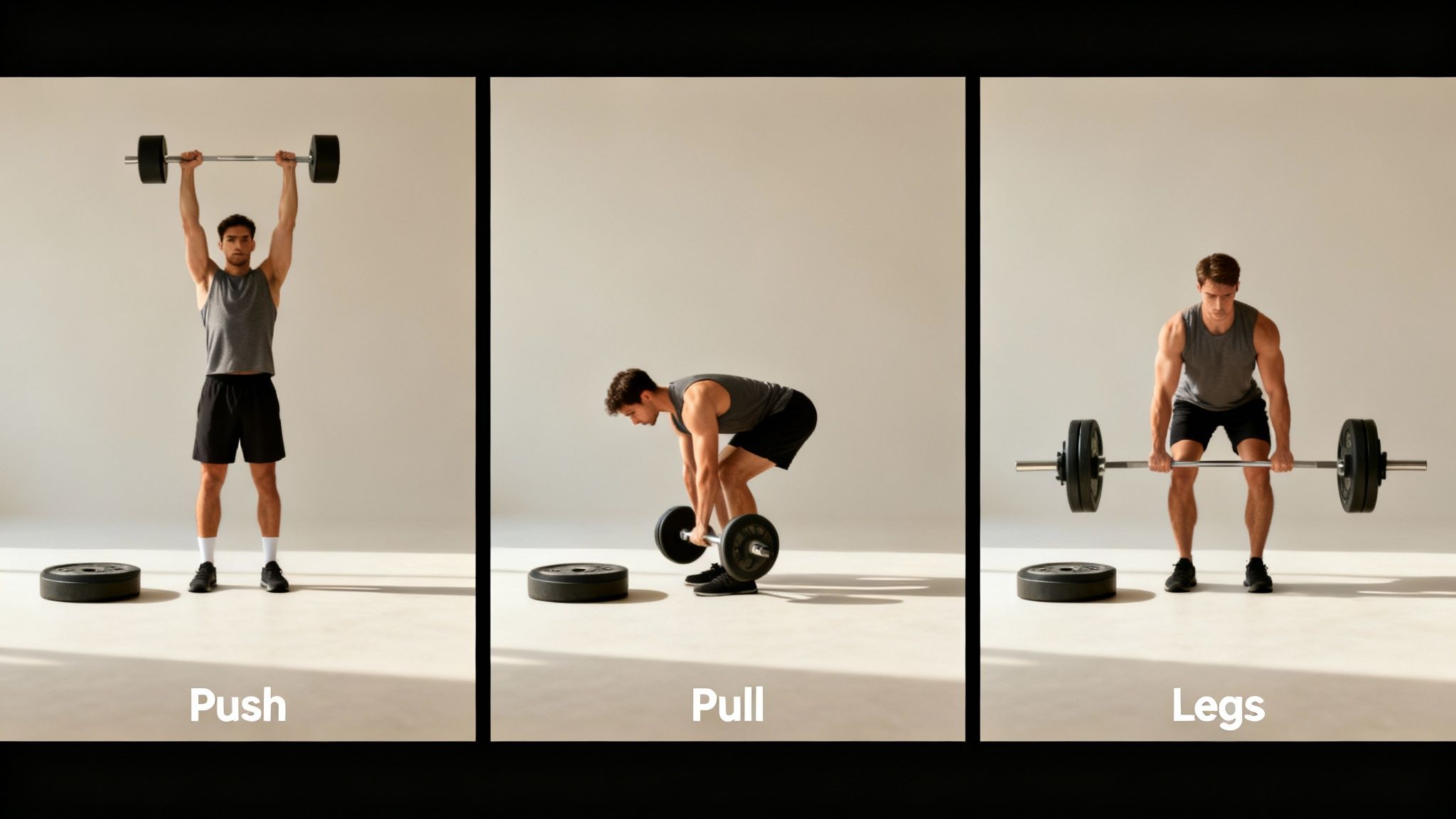
This 3 day exercise plan is designed to be performed with at least one rest day between each session. A common and effective schedule is training on Monday (Push), Wednesday (Pull), and Friday (Legs), giving your body the weekend to fully recover.
The PPL Weekly Breakdown
Unlike a full-body plan where you train the same movements each session, a PPL split dedicates an entire workout to related muscle groups. This lets you pack in more exercises and sets for each muscle, providing a powerful stimulus for growth. You can learn more about finding the right training volume in our article on how many exercises per muscle group you should aim for.
Here’s what your training week will look like:
Day 1: Push Day (Chest, Shoulders, Triceps)
- Barbell Bench Press: 3 sets of 6-10 reps
- Seated Dumbbell Shoulder Press: 3 sets of 8-12 reps
- Incline Dumbbell Press: 3 sets of 8-12 reps
- Dumbbell Lateral Raises: 3 sets of 12-15 reps
- Tricep Pushdowns: 3 sets of 10-15 reps
Day 2: Pull Day (Back, Biceps)
- Pull-Ups or Lat Pulldowns: 3 sets of 6-10 reps
- Bent-Over Barbell Rows: 3 sets of 6-10 reps
- Seated Cable Rows: 3 sets of 8-12 reps
- Face Pulls: 3 sets of 15-20 reps
- Dumbbell Bicep Curls: 3 sets of 10-15 reps
Day 3: Leg Day (Quads, Hamstrings, Glutes, Calves)
- Barbell Back Squats: 3 sets of 6-10 reps
- Romanian Deadlifts: 3 sets of 8-12 reps
- Leg Press: 3 sets of 10-15 reps
- Leg Extensions: 3 sets of 12-15 reps
- Seated Calf Raises: 3 sets of 15-20 reps
Aim for a 60-120 second rest period between sets for heavier compound lifts and 45-60 seconds for smaller isolation movements.
Why This Split Works So Well
The PPL split aligns perfectly with established principles of muscle growth and recovery. Resistance-training guidelines from major organizations generally recommend working each major muscle group 2–3 times per week, with at least 48 hours between sessions.
While a PPL routine only hits each muscle group directly once a week, many muscles get secondary work—for example, your shoulders and triceps assist during bench press. Meta-analyses show that when weekly volume is matched, spreading it over a few days can yield excellent hypertrophy and strength gains. In fact, studies on beginner programs often report strength increases of 20–40% on key lifts over 8–12 weeks with just three weekly sessions.
The Push/Pull/Legs split is an exercise in efficiency. By grouping muscles based on their function, you minimize overlap between workouts and maximize recovery time, allowing you to train with higher intensity each session.
This focused approach means you can push each muscle group closer to failure, which is a key driver of muscle hypertrophy. When you show up for Pull Day, your back and biceps are fresh and ready to go, completely recovered from the previous Push Day.
Adjusting The Plan For Your Level
This PPL plan is a solid template, but it absolutely should be adapted to your current abilities. The goal is to challenge yourself, not to get injured by lifting with poor form.
If You Need to Scale It Back (Regression):
- Barbell Lifts (Squat, Bench, Row): Substitute these with their dumbbell equivalents. Dumbbells require more stabilization but allow for a more natural range of motion and are often safer for learning.
- Pull-Ups: If you can't do a full pull-up yet, use the assisted pull-up machine or switch to Lat Pulldowns. Focus on a full range of motion.
- Romanian Deadlifts: Start with light dumbbells or even a kettlebell to master the hip-hinge movement pattern before loading up a barbell.
If You're Ready to Advance (Progression):
- Increase Load: The most direct way to progress is by adding weight to the bar. Once you can comfortably hit the top end of the rep range for all sets, it's time to go a little heavier.
- Increase Volume: You can add an extra set to your main compound lifts, moving from 3 sets to 4 sets.
- Improve Form and Tempo: Slow down the eccentric (lowering) phase of your lifts to a 3-4 second count. This increases time under tension and can spur new growth.
A smart fitness app like Zing Coach can automate these adjustments for you. By tracking your performance and asking for feedback, it intelligently modifies your PPL plan, ensuring you’re always progressing at the right pace. It takes the guesswork out of the equation and keeps your workouts perfectly tuned to your evolving strength.
Your At-Home No-Equipment 3 Day Routine
One of the biggest myths in fitness is that you need a gym membership to get a killer workout. Not true. Your own body is an incredibly effective and versatile piece of training equipment. With the right plan, you can build serious strength and endurance right from your living room.
A no-equipment 3 day exercise plan is the perfect answer for anyone who values convenience, flexibility, and real results. This routine is built on foundational bodyweight movements that hit every major muscle group, proving that a lack of equipment is never an excuse. The focus here is on how you move and the intensity you bring, not just going through the motions.

The key is to perform this plan on non-consecutive days. Think Monday, Wednesday, and Friday. This gives your body the time it needs to recover, adapt, and come back stronger.
The No-Equipment Weekly Schedule
Each workout is a full-body session designed to maximize calorie burn and muscle stimulation. We'll use similar movement patterns each day but with slight variations to keep your body guessing and prevent you from hitting a wall.
Day 1: Foundation and Strength
- Bodyweight Squats: 3 sets of 15-20 reps
- Push-Ups (from knees or toes): 3 sets to near failure (stop 1-2 reps short of your absolute limit)
- Glute Bridges: 3 sets of 15-20 reps
- Plank: 3 sets, hold for 45-60 seconds
- Jumping Jacks: 3 sets of 60 seconds
Day 2: Unilateral and Core Focus
- Alternating Lunges: 3 sets of 10-12 reps per leg
- Pike Push-Ups: 3 sets to near failure
- Single-Leg Glute Bridges: 3 sets of 10-15 reps per leg
- Mountain Climbers: 3 sets of 45 seconds
- Bird-Dog: 3 sets of 10-12 reps per side
Day 3: Power and Endurance
- Jump Squats: 3 sets of 10-15 reps
- Decline Push-Ups (feet on a chair): 3 sets to near failure
- Reverse Lunges: 3 sets of 10-12 reps per leg
- Burpees: 3 sets of 8-10 reps
- High Knees: 3 sets of 45 seconds
For every exercise, shoot for a 30-60 second rest between sets. If you want to ramp up the cardio challenge, keep those rest times on the shorter side.
Making Bodyweight Training Harder
So, without weights, how do you keep getting stronger? This is where bodyweight training becomes an art form. You have to get creative and manipulate other variables to increase the challenge. For a solid primer, check out this guide on how to start strength training at home.
Here are a few of my favorite techniques to crank up the intensity:
- Tempo Training: Slow things way down. For a squat, try taking 3 seconds to lower yourself, pausing for 1 second at the bottom, and taking another 3 seconds to come back up. This skyrockets the time your muscles are under tension, which is a huge driver for growth.
- Reduce Rest Time: Slice your rest periods between sets from 60 seconds down to 45 or even 30 seconds. This will seriously challenge your muscular endurance and turn your session into a high-intensity burner.
- Incorporate Plyometrics: Adding explosive moves like Jump Squats or Burpees is a game-changer. It dramatically increases the difficulty and the number of calories you'll burn.
- Increase Range of Motion: Make an exercise harder by making it longer. For example, elevating your feet on a chair for Decline Push-Ups forces more work onto your upper chest and shoulders.
You don't always need to add weight to get stronger. Mastering your own bodyweight through controlled tempo, explosive movements, and reduced rest is a powerful way to force your muscles to adapt and grow.
While you can get incredibly fit with just your body, you might eventually decide to add some gear to your setup. For a rundown of what's worth your money, this guide on home gym equipment essentials is a great place to start.
This is also where smart fitness apps really shine. An AI-powered tool like Zing Coach can generate endless bodyweight workout variations based on your progress. It can automatically swap in new exercises, tweak your reps and sets, and adjust tempos to make sure you never plateau. This keeps your at-home training fresh, engaging, and most importantly, effective.
Fueling Your Progress with Smart Nutrition and Recovery
Your hard work in the gym is the spark, but smart nutrition and recovery are the fuel that turns that spark into a raging fire. I've seen it a thousand times: people crush their workouts but neglect what they do in the other 23 hours of the day, and their progress screeches to a halt. A great 3 day exercise plan is only as effective as the recovery that supports it.
This isn't about getting bogged down in complicated diets or starving yourself. It's simply about giving your body the fundamental building blocks it needs to repair muscle, replenish energy, and come back stronger for your next session.
The Cornerstones of Workout Nutrition
You don't need a PhD in nutrition to get this right. Just focus on the big three macronutrients—protein, carbohydrates, and fats—and you'll be covering most of your bases. Each one plays a unique, vital role in your fitness journey.
- Protein is for repair. When you train, you create tiny tears in your muscle fibers. Protein provides the amino acids to patch them up and build them back stronger. Think lean chicken, fish, Greek yogurt, or plant-based powerhouses like tofu and lentils.
- Carbohydrates are for energy. Carbs are your body's preferred fuel source, especially for intense workouts. Go for complex carbs like oats, brown rice, and sweet potatoes for a steady stream of energy that lasts.
- Healthy fats support overall health. Don't fear the fat! Healthy fats are crucial for everything from hormone production to absorbing nutrients. You'll find them in avocados, nuts, seeds, and olive oil.
Getting the right balance of these macros is a huge piece of the puzzle. Honestly, learning how to speed up muscle recovery through proper fueling is a total game-changer.
Calculating Your Calorie Needs
While the quality of your food is a big deal, the quantity is just as important for hitting your goals. The right number of calories gives your body enough gas in the tank to perform and recover, without storing any excess as unwanted body fat.
Figuring out this number can feel like a chore, but it really just comes down to your Basal Metabolic Rate (BMR) and Total Daily Energy Expenditure (TDEE). These are just fancy terms for estimating how many calories you burn at rest and throughout your day.
Your daily calorie target is the foundation of your entire nutrition plan. Eating too little will sabotage your recovery and energy levels, while eating too much can lead to fat gain, no matter how hard you're training.
For a detailed walkthrough, our guide breaks down exactly how to calculate daily calorie needs for your specific goals. It's also where smart apps like Zing Coach come in handy, as they can automate this whole process, syncing with your workouts to give you personalized calorie targets without any of the guesswork.
Recovery Strategies Beyond Rest Days
Recovery is an active process. It’s so much more than just taking a day off from the gym. What you do on those "off" days can make or break how you perform in your next workout.
Sleep is your most powerful recovery tool, period. When you're in a deep sleep, your body releases growth hormone, which is absolutely critical for repairing muscle tissue. Aiming for 7-9 hours of quality sleep per night is probably the single most effective thing you can do for your results.
Hydration is another non-negotiable. Water helps shuttle nutrients where they need to go and flushes out metabolic waste. Even slight dehydration can cause your performance to plummet.
Finally, think about weaving in some active recovery techniques on your rest days.
- Light walking or cycling: This gets the blood flowing to sore muscles, helping to clear out the junk that makes you feel stiff.
- Stretching or yoga: A great way to improve flexibility and ease muscle tightness.
- Foam rolling: This is a form of self-massage that can work wonders on sore spots and improve your range of motion.
When you pair a solid 3 day exercise plan with intelligent nutrition and dedicated recovery, you create a powerful system for consistent, sustainable results.
Got Questions About 3-Day Workout Plans? We've Got Answers.
Jumping into a new fitness routine always brings up a few questions. A solid 3-day exercise plan is an awesome way to build strength and consistency, but it’s totally normal to have some "what ifs" and "how tos" floating around. Let's clear up some of the most common ones so you can get started with confidence.
Can You Really Build Muscle Working Out Only 3 Days a Week?
You absolutely can. For most of us, especially if you’re in that beginner-to-intermediate stage, training three days a week is a sweet spot for muscle growth (hypertrophy). It’s not about living in the gym; it's about the quality of your workouts and, just as importantly, the recovery you get afterward.
A well-planned full-body or Push/Pull/Legs split makes sure you hit every major muscle group with enough intensity to trigger growth. The magic ingredient here is progressive overload—the simple idea of making your workouts a little bit harder over time. That might mean adding a little weight, pushing for one more rep, or just nailing your form. Pair that with enough protein and solid rest, and you've got a killer recipe for building muscle.
What Should I Do on My Rest Days?
First off, rest days are not "do nothing" days. Think of them as recovery days. Your muscles don't get bigger when you're lifting weights; they grow while you're resting and repairing. The best move is usually active recovery, which just means doing some light, low-intensity stuff that helps ease muscle soreness without stressing your body out.
A few great options for active recovery include:
- A brisk walk outside
- A gentle yoga or stretching session
- Foam rolling any tight spots
- A casual bike ride
But the most important thing? Prioritize getting 7-9 hours of quality sleep. That’s when your body’s repair crew really gets to work. Staying hydrated is also key for flushing out metabolic junk and getting nutrients to your muscles.
Treat your rest days like a non-negotiable part of your training. Skipping recovery is like skipping a workout—it will eventually catch up to you and slam the brakes on your progress.
How Do I Know When to Progress My Plan?
Your body is smart. It adapts. The biggest sign it's time to level up your plan is when your current routine starts to feel... well, routine. What used to be a challenge will eventually feel like just another Tuesday.
Keep an eye out for these signals that it's time to shake things up:
- You're cruising through all your sets and reps with perfect form, no problem.
- Your strength gains have hit a wall for a few weeks straight.
- You barely feel any muscle soreness the day after your workouts.
When you hit that point, it’s time to introduce a new challenge. You could increase the weight, swap in some more complex exercises, or even graduate from a full-body routine to a PPL split.
Figuring out these progressions on your own can feel like a guessing game. That's where something like Zing Coach comes in. It uses AI to track how you're doing and automatically adjusts your 3-day exercise plan as you get stronger. This ensures you're always being challenged just the right amount to keep seeing results without the guesswork. Find your perfect plan at https://zing.coach.
Share this article


Authors